
Mapping resilience: how students are helping rebuild a Ukrainian town

A Look at Makariv
Before February 2022, Makariv was a quiet, rural community, known primarily for its agricultural production. Fewer than 15,000 people lived in this small city in the Ukrainian countryside. But this provincial community faced widespread destruction as the war with Russia unfolded.
Makariv is located just 50 kilometers west of Kyiv on a major transportation node to the capital city. The town was extensively damaged in the early days of the war. This semester, students in Adjunct Assistant Professor Nathan Hutson’s Planning Studio are developing a strategic plan to help Makariv rebuild, a plan that’s a broad effort with town leadership, the chief architect Nataliia Kruk, the Department of State’s Diplomacy Lab Program, Makariv Historical Museum, Kyiv National University of Construction and Architecture, and Taras Shevchenko National University of Kyiv.
“It's really hard to see [the situation] there,” said Sawyer McCarley, 3rd year Community and Regional Planning/Urban Design dual degree student. “There were some alarms, sirens going off during one class, and the students said, ‘Hey, I’ve got to go to the subway shelters because there are bombs coming in.’ It's been surreal.”
Hutson also recounts moments where students in Kyiv couldn’t log on to meet, due to attacks on their grid, which subsequently wiped out their internet capabilities. Though the challenges have been frequent, their resilience has proven greater.
Students’ goal at the end of this year-long project is to present their collaborative research to the U.S. Department of State and to the Ukrainian ambassador to the United States.
The Three Key Areas
Hutson's students are focusing their efforts on three key areas of their strategic plan: memorialization and green space, infrastructure and utilities, and transportation.
McCarley is working on memorialization and green space planning. The intention is to find ways to memorialize the people who have passed in war, while being sensitive to how personal this process is to the town itself. To do this successfully, Sawyer and his classmates communicate regularly with students at the universities in Kyiv.
“The biggest lesson for me has been how delicate this work is. You can tell when we're talking to the students or professors that this is super personal to them. You're building in people's backyards, so you want to make sure that it's done delicately,” said McCarley.
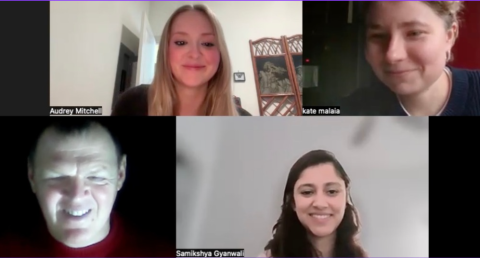
Image: Zoom interview students conducted with the Makariv Historical Museum
Mapping Progress and Pitfalls
A central element of the students’ strategic plan is the creation of a GIS map of Makariv. This map will highlight existing memorials across the town and serve as a foundation for planning future memorials and guiding rebuilding efforts. However, the students have encountered technological and political challenges in gaining access to updated maps of the area.
Because open-source mapping was restricted during the conflict, the students used resources from Rebuild Ukraine, a humanitarian aid organization, to gain a clearer picture of the town’s infrastructure, damage, and memorial sites. Rebuild Ukraine conducted an impact assessment of all buildings in the area, categorizing them on a scale from one to four, ranging from minor damage, such as broken windows, to complete demolition. Using this data, McCarley and his classmates are creating a layered map that documents existing destruction while identifying potential locations for new memorials that connect to different parts of the community.
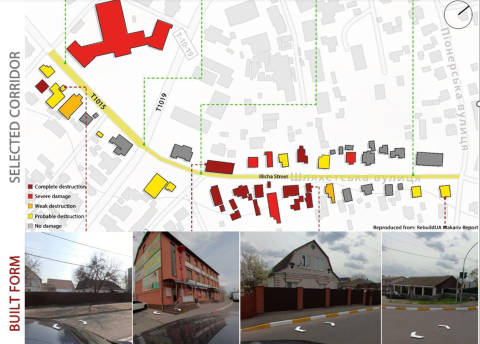
Image: UTSOA group presentation
Once they have their map solidified, students plan to survey the community for input on the proposed memorial locations.
A Sign of Life
To strengthen their planning efforts, students have studied how other regions turned to non-governmental organizations (NGOs) in the aftermath of major disasters, drawing lessons from places such as Poland and Beirut.
Alongside his teaching appointments at both the School of Architecture and the LBJ School of Public Affairs, Hutson collaborates with the Ro3kvit Urban Coalition for Ukraine, a network of Ukrainian and international specialists in architecture and urban planning, to advance designs and strategies for Ukrainian cities, including those that remain under occupation.
“Projects like this really give hope to the population,” Hutson explained. “We try to involve residents of occupied cities in the planning, and that helps them envision what life could look like once their city is liberated.”
Still, a pressing question lingers: why rebuild while the conflict continues?
“Ukraine is doing this to demonstrate strength and resilience, which has been fascinating to watch,” said McCarley. “Even though we’re planning for long-term recovery, we’re also rebuilding for the present reality. Much of our work focuses on configuring spaces to ensure they remain resilient both now and in the future.”