Q&A with Carlos H. Blanco

Carlos H. Blanco, a Salvadorian architect, artist and educator, is an interdisciplinary designer who explores architectural themes through his writings, paintings, and photography.
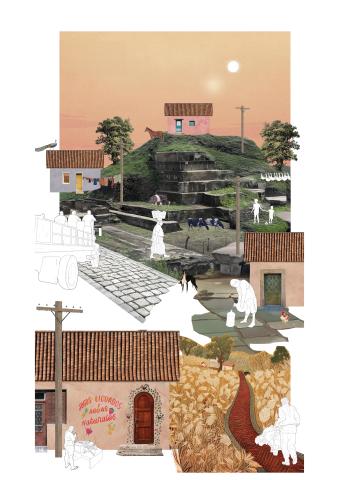
Blanco’s research focuses on domestic architecture, geography, exhibition curation, and the cultural production of marginalized urban and rural narratives in Latin America, with an emphasis on Central America. His work reflects on his personal experiences as an immigrant navigating complex environments and seeking solace in the built world. Prior to joining UT Austin in fall 2025, Blanco received a Graham Foundation grant to support his project “Casas de Cartón - Rural Memories of the Dry Corridor”.
We caught up with Blanco to learn more about his research, how his personal experiences are reflected in his work, and his teaching philosophy.
Your research blends architecture, geography, exhibition curation, and the cultural production of narratives in Latin America. What drew you to focus on this intersection? What questions are at the heart of your research?
Finding intersections, synergies and the assemblage of parts fascinates me. I find interest in examining connections between architecture and other forms of expression and cultural production, i.e. exhibitions, publications and art. I am seeking to develop architecture that operates beyond formal objects and become spatial archives of social, political, and environmental aspects. In Latin America, and through my research in Central America, we can explore how domestic and rural architectural farm typologies and laborers live in a constant flux of negotiations and adaptations to their environment and the systems they live in. These conditions reveal how architectural intelligence is embedded in everyday practices, informal systems and collective aspirations for survival. I am drawn to examine architecture as both a material and building practice and a cultural instrument. Geography provides the territorial and environmental framework; domestic architecture offers an intimate scale through which broader forces, such as land ownership, labor, migration, and climate, are spatially created; and exhibition curation becomes a production mode for translating these spatial narratives to a wider audience through disciplinary discourse.
At the heart of my research are questions of authorship, care, and agency. I leave you to interrogate your work and future endeavors through these questions of inquiry: How do marginalized communities produce space under conditions of political, economic and environmental constraint? What forms of architectural knowledge emerge outside formal practice? How can we use ancestral knowledge to engage these narratives not as problems to be solved, but as sites of intelligence, resilience, and cultural production? How can architects become holistic designers of society that operate with intentional care?
What can you tell us about your research and scholarly work for the project “Casas de Cartón”?
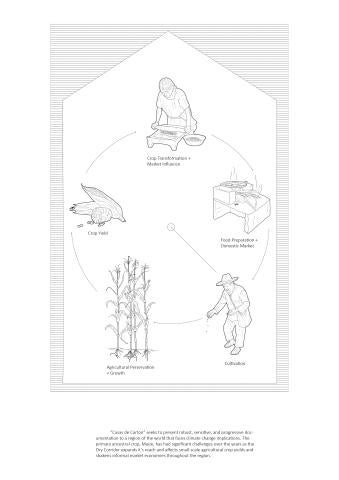
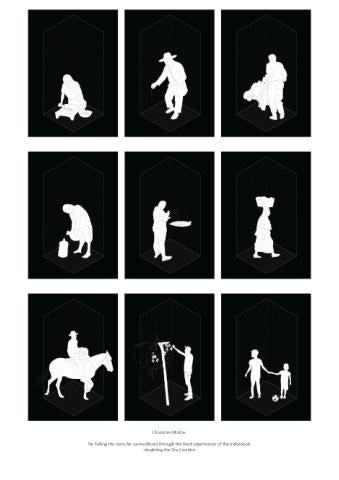
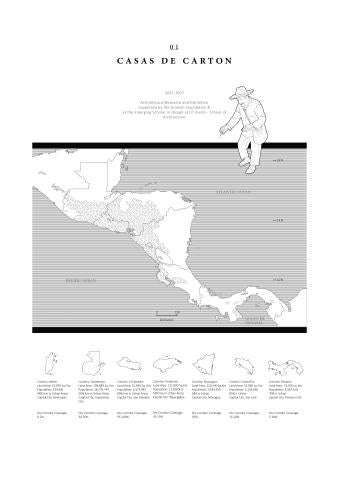
Casas de Cartón is an ongoing architectural research project that operates as an academic and practice based endeavor, and a personal investigation into my origins and territorial conditions of Central America. The research examines rural, urban and domestic architecture, across the Central American Dry Corridor (CADC), a region containing approximately 10 million people, who directly face the issues of a landscape scarred by environmental precarity, infrastructural fragility and political marginalization. Through descriptive documentation, drawing and cartographic studies, model-making and field research, Casas de Cartón explores a region’s adaptations and resiliency in the face of climatic disasters and ongoing territorial tensions. The research ties the dichotomical conditions of urban and rural life through the lived experiences of communities and focusing the narrative on the individuals who cultivate, distribute and promote regional agricultural production and wealth through formal and informal market systems. The project is particularly interested in how vernacular and informal constructions reveal site-specific forms of sustainability, stewardship and survivalhood.
As a scholarly series of inquiry and personal project, the work functions across multiple platforms and audiences. This project is intended to serve as an individual effort of empowering the collective, dedicated to the individuals
who face the onset of environmental precarity and the countless immigrants who have been displaced in the CADC.
As someone who has experienced immigration firsthand, the research is a lifelong pursuit of documenting, advocating and designing alongside communities navigating displacement, environmental vulnerability and the search for agency through space and design.
What should students know about your teaching emphasis and style? What can they expect to learn in your classroom this semester?
This is a wonderful question for inquiry into my teaching philosophy and approach. I believe that my teaching
emphasizes architectural design as an operative process, one that requests students to attune themselves to larger environmental, cultural and infrastructural systems within which architecture is situated. This requires students to open their eyes, minds and sketchbooks through rigorous research, communicative visual representation, and speculative design that is both poetic and precise.
I encourage students to scrutinize everything; to be critical observers, listeners, and responders to the conditions they grow, adapt and design for. There are plenty of questions to ask, and only by paying attention to the nuances of daily life, do we begin to become intentional agents that care how design can play an active role in spaces and broader territorial relations.
This spring semester, the students will profoundly develop their knowledge base of the environmental and cultural conditions of Puerto Rico, understanding its history and examining how fragile economic systems and centralized infrastructure limit climate adaptation and resilience. The vulnerability of Puerto Rico’s electrical infrastructure produces long-lasting lingering consequences following the hurricane season, affecting both urban and rural territories. Through territorial investigations, prototyping, and site-specific design, students will develop a capsule-thesis that will view the island through various lenses of inquiry, extracting layers of data to formulate their ideas.
Working together, we will develop what I define as “Instruments of Care”, architectural devices and systems that can serve to either alleviate, measure, or mediate issues of energy, agriculture, climate resilience and social
disconnect. I aspire to conduct my studio as a social collaborative learning space rooted in research-driven, iterative and critical inquiry. Beyond the technical and conceptual skills students will obtain, they will leave my studio with the skill set to enable them to engage complex sites with care, hope and imagination.
I wish every student to know that sometimes the smallest questions, those that linger in the back of the mind, can have the greatest impact on their education and the world. This is what I hope I can do; to evoke their voices to speak forward and onward, as architects and global citizens.