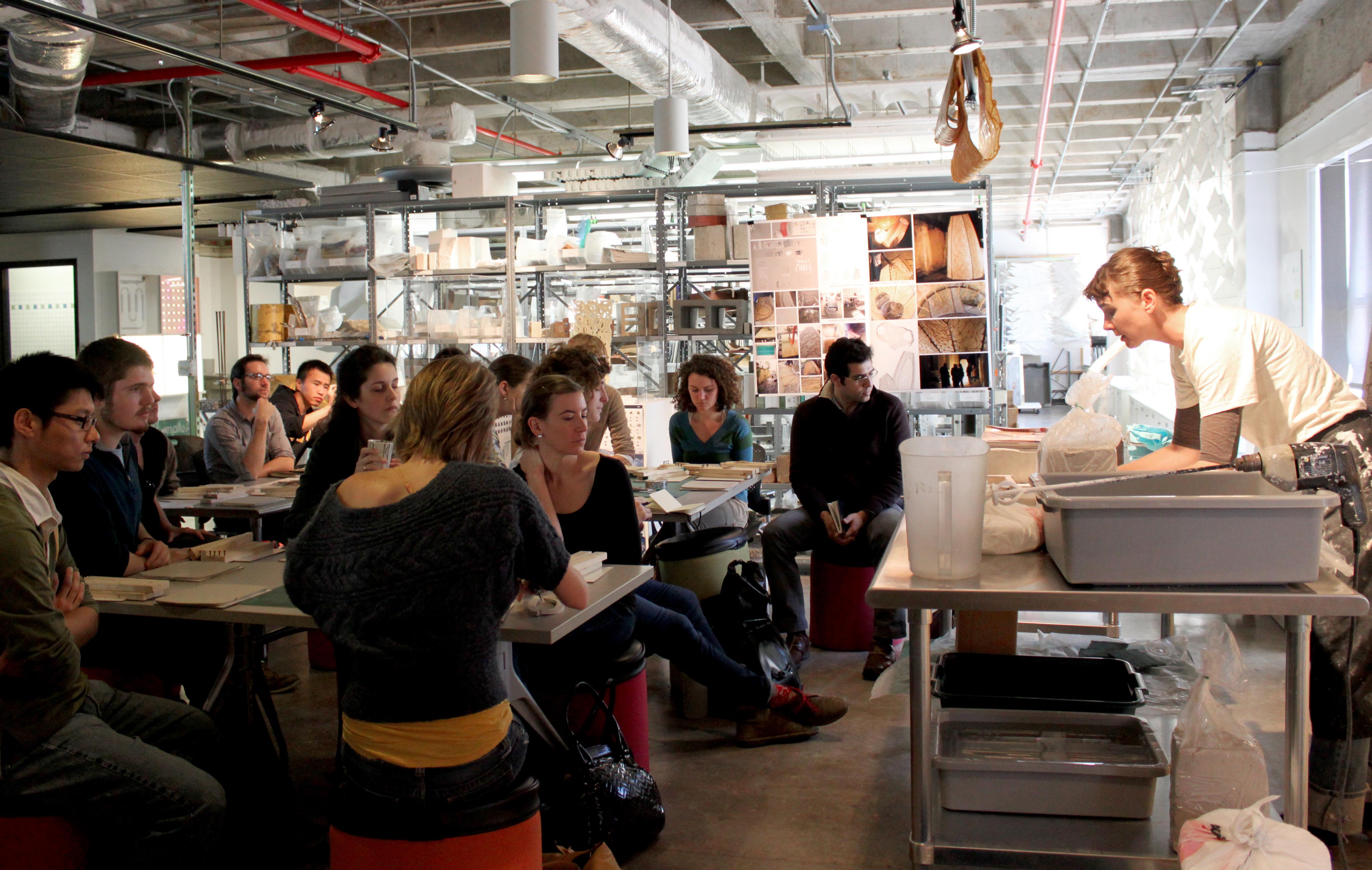
Five people in casual clothes gather in a workspace, working together to move or adjust a large wooden board. Some are lifting or supporting the board while others observe or assist. The room has large windows and industrial decor.
Exhibition, Materials Lab
Event status
Scheduled
Thursday November 18, 2010, 9:45am - Thursday December 2, 2010, 5:00pm

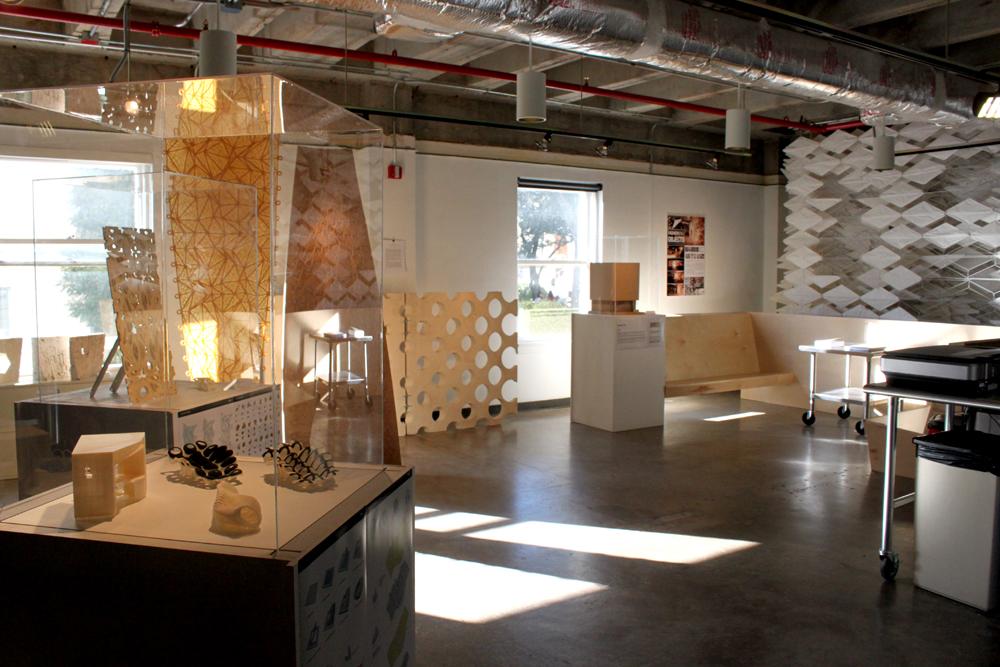
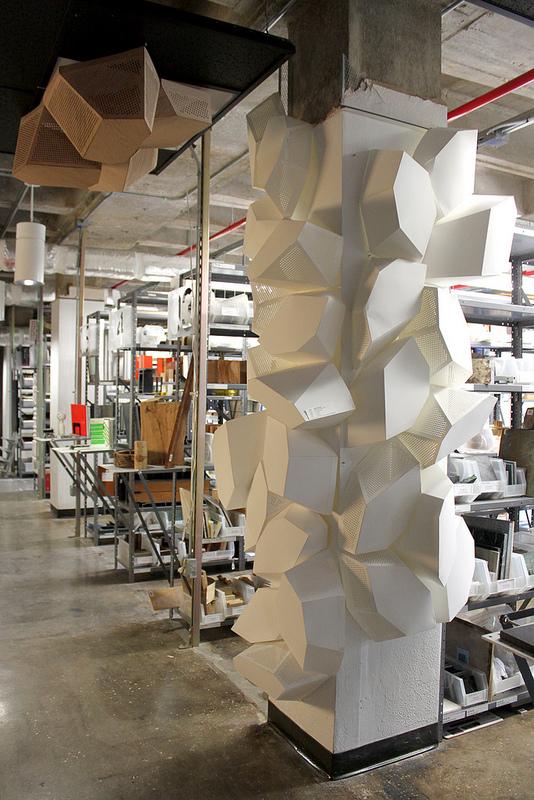
Using a variety of performance considerations, material efficiency, and production benefits, Briscoe fabricated limestone panels. The design of the apertures' transitions from closed to open are based on the following thermal and physical parameters: drainage for condensation, solar optimization, and a maximum 45-degree angle-axis of the water technology. Parameters within the information model database facilitate a dimensionally-controlled iterative process.

Curators
Danelle Briscoe, Sydney Mainster

Event status
Scheduled
Friday November 12, 2010, 12:00 - 1:30pm

n urban planning, many of the measures that we use to characterize the successes and shortfalls in the making of physical designs, social programs and urban spaces have a direct and significant relation to density. For some people and in many contexts, increasing density is clearly a goal—it increases vibrancy, economy, and more. For others, the desire is to limit density—to reduce the adverse impacts of overcrowding, contagion, and pollution. These and other notions are often debated, but all too often not thoroughly understood, as they are inherently complex.

Event status
Scheduled
Friday October 22, 2010, 12:00 - 1:30pm

Supported by a large demonstration grant from the US Department of Energy, the Pecan Street Project is a Smart Grid initiative led by a team of researchers from the University of Texas, National Renewable Energy Laboratory and the Environmental Defense Fund to develop and test an integrated clean energy smart grid in Austin. The Pecan Street Project is also actively supported by Austin Energy, the nation’s largest seller of green power and the first utility to create a green building code (which became the basis for the LEED rating system).

Silhouetted figures stand beneath a large, modern structure with angled solar panels casting long shadows on a wide, sloped concrete surface under a clear blue sky.
Exhibition
Event status
Scheduled
Monday September 13, 2010, 8:00am - Friday January 14, 2011, 5:00pm

Visual Resources Collection, Sutton Hall 3.128 and Battle Hall, ground floor hallway

Exhibit Opening:

Thursday, October 18, 2010 from 3-5 pm 

Visual Resources Collection, Sutton 3.128 

A minimalist sculpture made of thin black rods arranged horizontally and vertically, suspended on four thin metal legs against a plain light background.
Exhibition, Materials Lab
Event status
Scheduled
Tuesday June 1, 2010, 9:00am - Saturday September 3, 2011, 5:00pm

Interdigitation looks at the relationship between digital production and handwork. The exhibit is a semester-long material by-product investigating a simple laser-cut component made from a full sheet of matte board and assembled by hand. In the past, I have constructed a series of lamps using a similar component system; and this semester, I developed a systematic investigation of the component varying its size, shape, swivel, placement, and connection.

A design presentation board with diagrams, architectural drawings, charts, 3D exploded views of a cylindrical structure, grayscale interior views, and step-by-step process illustrations.
Exhibition, Materials Lab
Event status
Scheduled
Tuesday June 1, 2010, 9:00am

Computation, as a systems logic has gained a level of accessibility to designers in recent years offering them a generative model for iterative and data driven design processes. Recursive Assemblies explores this logic through the creation of design analysis and solution models locating intention and execution at the level of protocols rather than as instances. These digital assemblies utilize a parametric framework to incorporate computation into the design process, designing and testing parametric generative models.

Event status
Scheduled
Friday April 9, 2010, 12:00 - 1:30pm

Latin American cities have long faced a lack of adequate housing for low-income residents. From an emphasis on top-down state interventions and the development of large housing complexes, planners and policy-makers are now experimenting with various forms of participatory approaches and public-private partnerships to address the need for low-income housing. At the same time, low-income residents in informal settlements must continue to rely on self-help strategies to construct their homes.

Event status
Scheduled
Friday March 12, 2010, 12:00 - 1:30pm

As housing becomes increasingly unaffordable for the region’s poorest, many are looking to informal settlements outside the city as inexpensive places to make their home. This forum will explore informal settlement patterns in the peri-urban areas in Texas, specifically drawing on examples in the Austin region.

Event status
Scheduled
Friday March 5, 2010, 12:00 - 1:30pm

For over two decades, planners and community leaders have debated the merits of light rail in the Austin region. Although passenger rail services can accommodate the growing transportation demand facing the region and provide an alternative to increasingly congested highways, the region has been challenged in its effort to build a multimodal system. In the meantime, other regions have moved ahead with plans and succeeded in integrating rail into their regional transportation systems.