Material Methodologies: Jen Wong on the Foundation and Growth of the Materials Lab

Define “material literacy” — how can it shape a designer’s career and change the built environment at large?
Jen Wong: Material literacy is directly tied to curiosity about the world. Everything in the built environment is material, meaning every material decision that a designer makes is multiplied. With that comes an enormous responsibility to develop a deeper understanding of the materials we specify.
We can develop our material literacy beyond product life cycles and performance characteristics to the celestial and terrestrial history of materials. Developing one's material literacy isn’t a chore. It’s an integral part of a well-rounded existence: What amazing things exist in a world that is constantly morphing?
The Materials Lab builds material literacy by helping students both widen and deepen their material palette. We introduce products through a series of "material of the week" Instagram posts (@materials_lab). Over time, these have accumulated into an archive of the most compelling products in our library. We’ve featured dozens of products, from ubiquitous concrete masonry units (CMUs) and flexible polyurethane foam, to synthetic limestone used in carbon-negative concrete, and recycled, reversible bike lane separators utilized by the City of Austin.
How do you procure new materials?
One of my favorite ways to identify new materials is through direct requests. Every semester, we learn about new materials through the diverse research interests of our visitors. These include students and faculty from the SOA, but also local professionals and those in adjacent realms such as textiles, art, engineering and scenic design. Recent requests include Texas river rock, weld sizes and types, rammed earth, and WUI-compliant bamboo decking.
Thanks to a $60,000 grant from the Angelo Donghia Foundation in 2022, we expanded our collection of sustainable materials and produced two curated exhibitions. These exhibitions have enabled us to grow the library in new directions and explore themes in collaboration with SOA faculty research, and they've now become an annual exercise. So far, we've looked at cross-industry materials for creating sheltered space with Ria Bravo, sustainable substitutes with Igor Siddiqui, systems that support vegetation with Danelle Briscoe, and products with inherent fire resistance with Nichole Wiedemann.
How does your system offer opportunities for discovery?
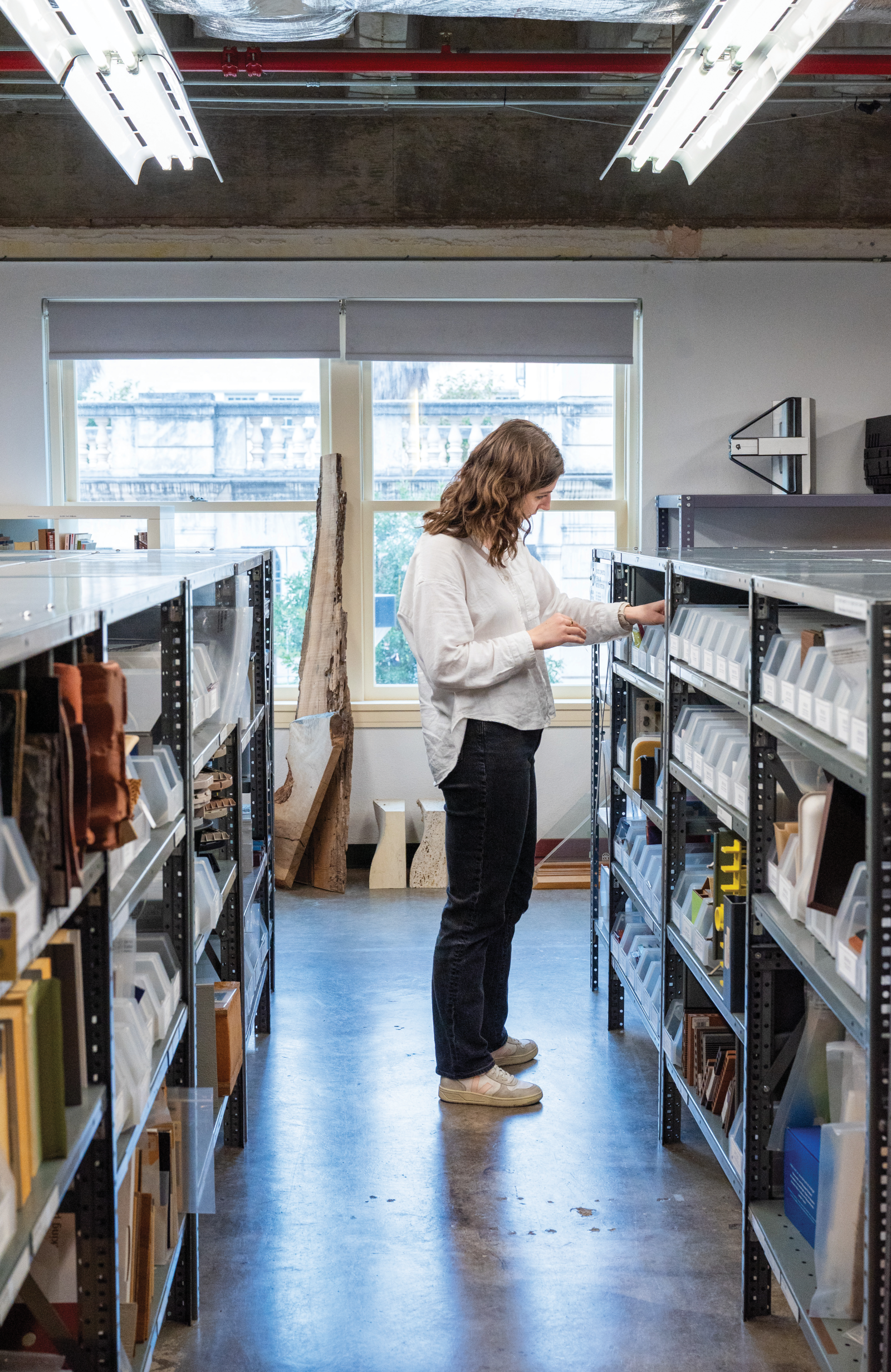
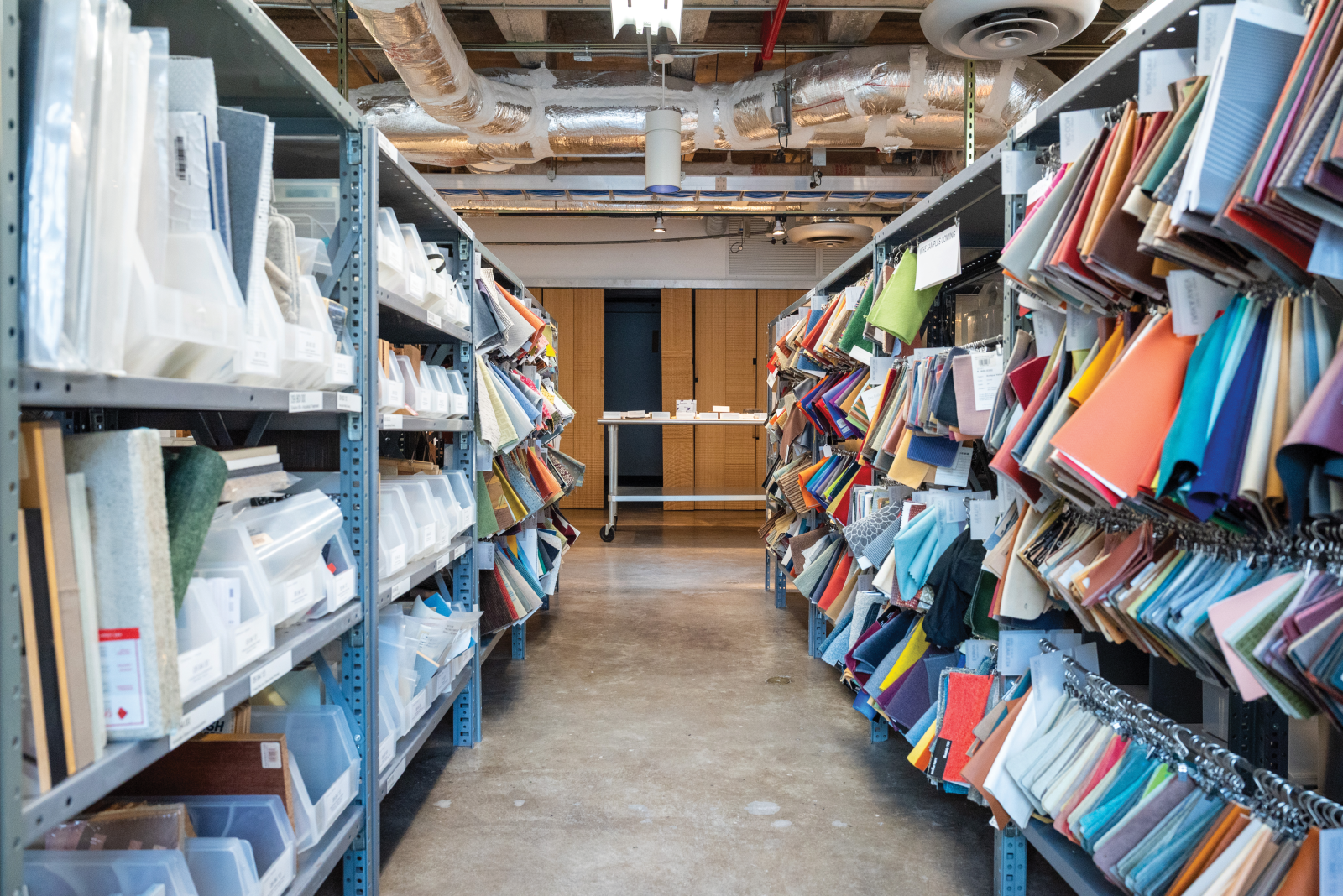
There are several ways one might find products. In-person visitors can discover material products by simply wandering around to see what catches the eye. If you're most interested in physical characteristics — color, pattern, rigidity, transparency — this may be the way to go. Going deeper, you could use the CSI MasterFormat. It’s an indexing system for the organization of construction specifications that dictates how products are organized on our shelves.
Another great way to browse is through our online catalog. Users can search by manufacturer, product name, or via 500-plus material attributes, which are divided into five major categories: Composition, Form, Process, Application and Properties. For example, you could search for a grass-based flooring product that also contains recycled content.
What are your future programming goals and new material offerings?
Based on the success of our collaborative exhibitions, we plan to continue curating strategically through the lens of circularity. The mutual benefits have been high: We deepen the Materials Lab's collection with an infusion of new products, while our collaborators develop existing research or tackle new topics. In future semesters, I can see these expanding to include other departments. There is so much exciting material innovation happening across campus, with rich overlaps to our work at the SOA.
I'm also interested in further developing a collection we curated in 2021, Materials in Texas, which surveyed building materials with Texas origins. Building on that work, I’d like to assemble a regional directory of products. This could be assessed using the Common Materials Framework’s five metrics of sustainability: climate health, human health, social health and equity, circularity, and environmental health. While tweaking the requirement of origin, we could assess products for their overall regional appropriateness. I can see most success for this as a collaboration with local practitioners, including our strong network of alumni.
As the Materials Lab reaches its 25th year, how do you envision the next 25 years?
The goal of our collective work is to produce a built environment permeated and defined by appropriate materials and building strategies. We want visitors to default to products that are biogenic and regionally sourced, within circular systems. With this greater goal in mind, the Materials Lab can serve as a regional authority on the products, assemblies, and building methods that are most appropriate for Central Texas and other areas with overlapping challenges and opportunities: hot and humid climates, water-challenged municipalities, and sites with proximity to urban and agricultural by-products.
The Materials Lab offers a unique link between academic and applied research. I hope it continues to serve the community with a comprehensive collection of material products that not only reflect the built environment of its time, but project beyond.