
Q&A with Assistant Professor of Interior Design Hans Tursack
January 5, 2026
To celebrate his addition to the school, we conducted a Q&A with Assistant Professor of Interior Design Hans Tursack to learn more about his creative and educational work.

Hans Tursack is a designer from Philadelphia, Pennsylvania. He received a BFA in studio art from the Cooper Union School of Art, and an M.Arch from the Princeton University School of Architecture where he was the recipient of the Underwood Thesis Prize. He was the 2018-2021 Pietro Belluschi Fellow at the MIT School of Architecture + Planning and a Visiting Assistant Professor at the Sam Fox School, Washington University in St. Louis (2022-2023). Hans is currently a Ph.D. student in Electronic Arts at the Rensselaer Polytechnic Institute’s (RPI) Department of Humanities, Arts and Social Sciences and is working on his dissertation.
In the fall, Hans joined us as one of our newest permanent faculty members.
Your body of work includes a wide range of publications and projects. What are some of your career highlights? What are you currently researching?
My favorite recent exhibition was a collection of physical models, material studies, and animations that I displayed at the Rensselaer Polytechnic Institute’s Experimental Media and Performing Arts Center (EMPAC) in Troy, New York. EMPAC is a beautiful Grimshaw building and a gem on RPI’s campus. They have an incredible program every year of artists working at the intersection of new media and performance art. I was grateful to receive a grant from the Institute and time to work within one of their black box galleries this past summer (July-August 2025) to test a series of ideas with the EMPAC staff and engineers, and mount an exhibition of my work.
I’m currently working on a dissertation for a PhD in Electronic Arts within RPI’s School of Humanities Arts and Social Sciences. The program is largely designed for artists working with new technologies who benefit from producing art within the context of an engineering school. My creative work and research is focused on borrowing tools from the animation and gaming industries and creative coding platforms and re-purposing them for architectural concept-generation. I’m currently designing a series of software studies that generate architectural geometries in game-like environments. Over the summer at EMPAC, I showed a group of speculative animations, resin-cast 3D printed material studies, and two scale architecture models (an urban tower and a small house). The exhibition was accompanied by a modular synthesizer score by an amazing Brooklyn-based electronic musician Matthew Ryals that created a very specific atmosphere for the work. Part of my research is involved with how we can reconceive architectural geometries as a kind of animate matter. The exhibition allowed me to think about how something as prosaic as 3D modeling could be reconceived as an aesthetic project through new concepts in video game studies, HCI (human-computer interaction) and posthumanist media studies.
In your 2024 publication, Spectral ruins: Empathy with inanimate material movements, you explored the idea that working through digital simulations of material movements can elicit a particular kind of experience in the user that is conducive to empathizing with inanimate matter. What made you interested in this topic?
That essay is basically the kernel of my dissertation. At RPI I've been researching and developing design work that explores connections between new media and architectural geometries through the lens of eco-criticism and New Materialism. In that essay, I looked at a series of contemporary art and architectural practices that work with simulations and animations as a means of generating geometric concepts. I’m particularly interested in practices that work with a kind of formlessness—this is to say practices that combine digital objects like soft bodies, fluid simulations, particle simulations and rigid bodies to simulate “messy” materials in the real world. This is a very old idea in architecture (form-finding that leverages the erratic behaviors of so-called inanimate materials in motion). What’s new in the work of the practices I look at, and in my own design work is a.) the use of digital tools to simulate these behaviors (many come from the game and commercial film industries), and b.) the idea of looking at matter through the lens of eco-theorists who want to break down binaries like animate/inanimate, nature/culture, sentient/non-sentient etc. These are figures like the New Materialists, eco-critics, and theorists in STS and feminist technoscience (N.Katherine Hayles for example). In pop culture, eco-fiction writers like Jeff VanderMeer have successfully brought some of these more arcane philosophical ideas into our collective imaginary.
I became interested in these topics in part through my professors in graduate school several years ago. Stan Allen’s architectural interest in mining strategies from postminimalist sculpture continues to be a huge influence on me. I am also (very much after the fact of my M.Arch studies) appreciating Axel Kilian’s many lectures that addressed simulations, gaming, creative coding and human-computer interaction. Axel introduced me and my M.Arch cohort to the Processing coding platform in our second studio in the M.Arch sequence. I now understand how formative that experience was. He was teaching us how to invent our own tools and begin to develop research questions from first principles—even if that meant working slowly and with visually paired-down vocabularies at the beginning of the process.
What about the UT School of Architecture made you want to come and teach here? What is the most enjoyable part of the experience so far?
The reputation of the faculty drew me to the school. UT has a strong, international reputation of being a program versed in cutting edge, digital tools. I knew about the SOA well before I arrived through the work of the faculty—their publications, pavilions, student work, prototypes, and conference papers. I also taught under Dean Woofter at the Washington University in St. Louis, Sam Fox School as a visiting assistant professor a few years prior to joining UT, and I was excited to join the faculty in Texas under her leadership.
The SOA is very active and my program in Interior Design is a lively mix of practitioners and academic-designers working on the history and future of materials, aesthetics, fabrication, and sustainability. The Interior Provocations: WEATHER symposium organized and hosted by the Interiors faculty was a high point of the Fall 2025 semester. Bringing so many international voices to the SoA to discuss the future of interiors and climate (framed through several different lenses throughout the event) was a fantastic example of the SoA’s engagement with history, theory, politics, and engineering.
I will also say that my students have been fantastic this semester. I taught an advanced studio this Fall and I had a mix of interiors, architecture, graduate and undergraduate students in my course. I gave them a difficult design problem—they were tasked with designing a media lab inside of former Albert Kahn factories using field-like plan strategies. I asked them to learn new software, representational techniques and fabrication methods that were unfamiliar to many. They produced beautiful, large, ambitious physical models, digital animations/simulations and drawings + diagrams for their final review. I was impressed throughout the term by their ambition and drive, but also with their collective spirit and collegial attitudes in the studio.
What is your advice for students that want to embark on a career in design?
Well, I think it's imperative to learn new software platforms, digital fabrication workflows, and engage with emerging building technologies. What we think of as design is a concept that is radically changing in real time. That said, I also believe in using these tools critically. I think many of us in the department are developing research questions around new technologies and are certainly excited about how AI and newer platforms from other industries (the Unreal Engine from commercial gaming for example) are changing design and representation. I would also argue however, that the black-boxing of software (and especially AI platforms) is a huge issue for students and emerging designers. If I were a student beginning a career in design, I would want to have a strong foundation in coding and scripting without the use of AI tools before jumping into platforms whose mechanics are largely opaque.
We all have to engage with the ethics and environmental costs of new technologies as well. For me, (in my small corner of academic-design that intersects with new media) this means engaging with posthumanist media theorists who openly discuss the material realities of computational platforms, and the way we give visual form to so-called “nature” when we represent our environment in architectural renderings, animations, and models. For students, I would say that the future of our field will be largely determined by how we approach climate and technology. I believe this means addressing the first principles of both of these topics—along with their urgent ethical and political questions—in our studios and seminars daily.

Ghent House (physical model)
Installation View, EMPAC RPI, Troy New York
Year: 2023, Summer, 2025
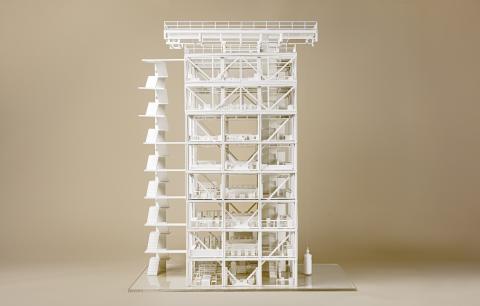
Tower Prototype
Photo Credit: Allie E.S. Wist
Year: Summer, 2025
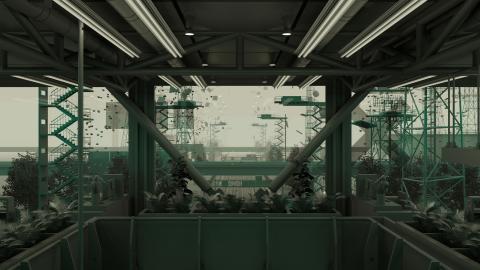
Interior Perspective, Tower Prototype
Year: Fall, 2025