Q&A with Professor Kory Bieg

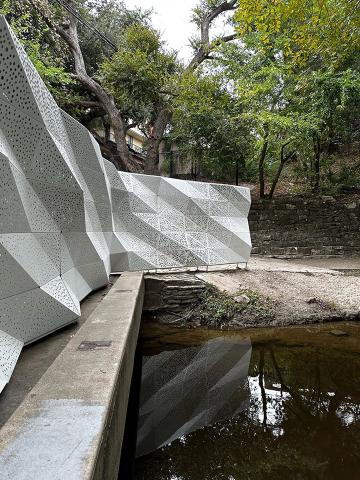
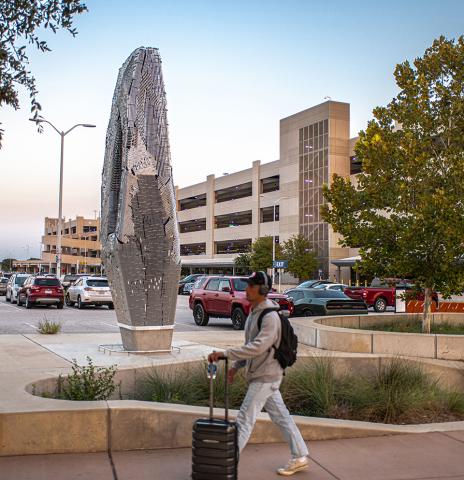
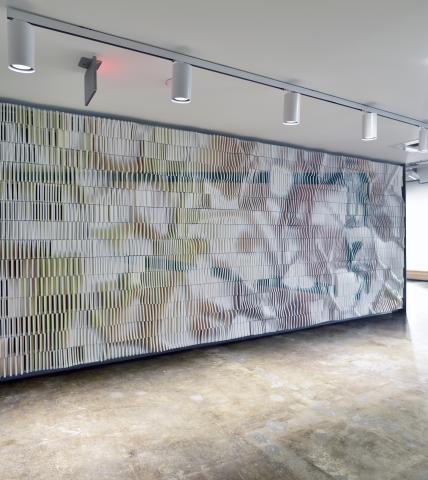
From the iconic ONDA wall in the West Mall Building to supporting the School of Architecture's academic operations as Associate Dean of Academic Affairs, Kory Bieg’s presence is felt on campus.
Bieg is a licensed architect, founder of architecture, design, and research office OTA+, and now a full professor of architecture at UTSOA. His professional work specializes in the use of current, new, and emerging digital technologies for the design and fabrication of buildings, building components, and experimental installations.
How have your research interests and creative interests grown over the years since you first joined us in 2012?
When I joined UT in 2012, my work focused primarily on small-scale digital fabrication—designing and building temporary installations while testing the limits of computational modeling, rendering, and simulation. I have continued those explorations, but UT has given me the opportunity to translate them into larger and more permanent work, including public art, architectural installations, and buildings. More recently, artificial intelligence has opened a new frontier. I have been fortunate to contribute to the emerging conversation through lectures, exhibitions, publications, and collaborations with academic and industry groups, while also bringing AI into the classroom. In many ways, I approach it as I did earlier digital tools: by encouraging students to experiment, build their own workflows, and test what the technology can—and cannot—do.
What’s your outlook on combining digital technology with physical making? How should students explore this combination?
I am still surprised that digital technology and physical making are sometimes presented as opposing approaches—digital versus analog—when they are now deeply intertwined. Digital tools are ubiquitous in practice, so design education should be looking beyond whether to use them and asking what comes next: How can we use every method available to meaningfully advance the field? Students should not feel compelled to choose one approach over another. They should learn to move fluidly among drawing, computation, material experimentation, and fabrication, selecting the best tool for each stage of a project. Most importantly, they should resist defaulting to what is familiar. Trying something new—and occasionally failing—is often where the most valuable learning occurs.
In your opinion, how do you see AI shifting the field of architecture? How should these shifts be addressed or considered in design education?
AI is one of those rare technological shifts affecting not only architecture, but nearly every dimension of culture and society. Earlier developments such as CNC fabrication or BIM significantly changed architectural practice, but their influence was relatively specific to our field. AI is arriving from the outside and transforming the broader context in which architects work. We need to adapt existing technologies to design, but we should also be developing our own tools from the inside out—tools grounded in spatial thinking, material knowledge, and the particular intelligence of our disciplines. Design education cannot shy away from AI. It must help students understand its possibilities, limitations, ethics, and implications for authorship and labor. Our relevance will depend not on resisting change, but on applying the creativity we already possess to reimagine both the profession and the educational models that support it.
As a registered architect in Texas, what makes Austin a meaningful site for architecture?
Austin is a great city for experimentation. When I moved here, I was told that new industries and business models are often tested in Austin first because, if they succeed here, they can succeed elsewhere. The city seems to have the right mix of people who will embrace an innovative idea—but only if it is good. Over the years, I have watched everything from scooters and self-driving cars to F1, SXSW, and new restaurant concepts take hold here, and then sometimes spread across the country. Architecture has some of that same energy. Companies such as ICON are leading the way in 3D-printed housing, and Austin has exceptional local architects and designers whose work stands alongside that of much larger cities. There is a strong design culture here and a public with a genuine taste and expectation for good architecture. I would still like to see more of Austin’s experimental spirit expressed in its buildings, but that’s the next chapter.