Simulating Democracy: Housing and Computation in Modern Latin America
Simulating Democracy: Housing and Computation in Modern Latin America
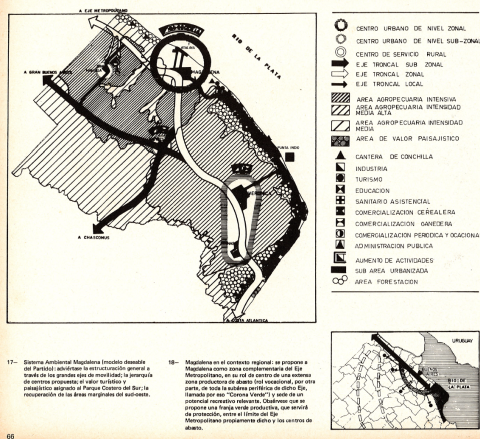
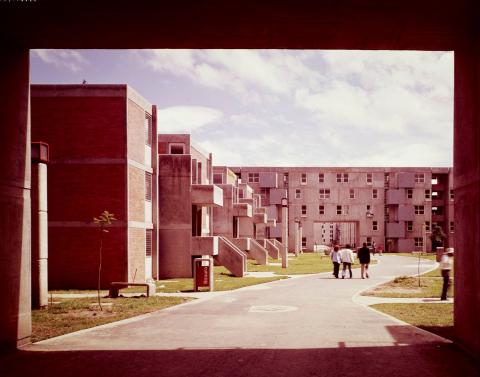
This exhibition looks at media produced by government agencies in Mexico and Argentina to promote two state-funded development programs in the 1970s. Both governments created advanced computational research centers to attract international investment and both claimed that the use of computation would catalyze democracy and participation.
Building on the UTSOA 2025-26 Planetary Imaginaries, this exhibition argues that these two housing programs are not simply local experiments but demonstrate how early computerized systems models translated military computation into tools for managing the planet as a single integrated system. In these two housing programs, the inclusion of global sociological studies, climatology reports, census data, and migration statistics illustrates how housing became a global object of technological evaluation and a rhetorical device in local political discourse and global development discourse.
The history of computation has typically excluded the histories of Asia, Africa, and Latin America. This exhibition foregrounds Mexico and Argentina as leaders in computational governmentality to demonstrate that the history of computation is not simply a history of institutions in the United States and Europe but played out over a much wider geography, where bureaucrats, artists, academics and government officials all over the world helped shape computer science in their own contexts.
About Michael Moynihan
Michael P. Moynihan's research focuses on the global history of housing during the Cold War/development era and broader questions about politics, technology, and expertise in architectural practice.
He is currently working on a book manuscript titled Systems Will Prevail: Global Housing and the Decline of the Professional Architect, which explains why in the 1970s a quarter of the world’s architects suddenly found themselves unemployed and contextualizes how a shift in expertise related to international housing policy has shaped the education, careers, and salaries of architects in the past five decades. Rather than emphasizing episodes when architects were excluded from the production of housing, this book looks at exceptions when some architects working in national housing ministries recognized their loss of agency and tried to resolve the situation by creatively engaging in the newly emerging information systems.
With the support of the Land, Space, and Identity in the Americas Fellowship, Michael is working on a second book project focused on the relationship between architectural practice and artificial intelligence. This research is a prehistory to our current fascination with decision-making software by examining the popularization of information science in international development policy in the 1970s. During this decade, architects and other experts were asked to contribute research at a global scale that abstracted and oversimplified complex cultural and political realities. The categories of data used in algorithms that would come to define international housing policy such as exploding populations, food exports, housing scarcity, unemployment, and pregnancy rates served less to improve conditions than to entrench already existing assumptions. This book will argue that this was not simply a problem of technological immaturity in the 1970s. Experts who create these decision-making tools today continue to hold certain values and views of the world and these technologies have the effect of reinforcing geopolitical hierarchies and expanding social inequality.